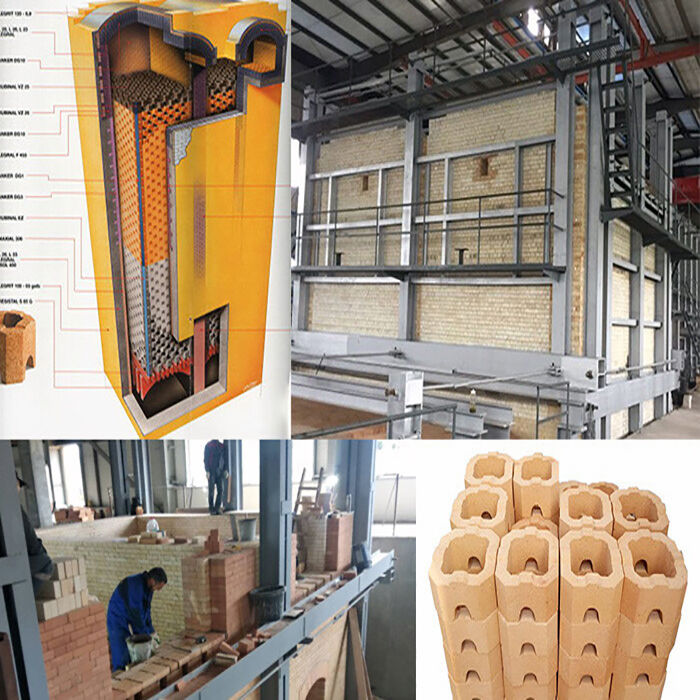
| ব্র্যান্ডের নাম: | JEFFER |
| মডেল নম্বর: | কাস্টমাইজেশন |
| MOQ.: | 1 সেট |
| মূল্য: | আলোচনাযোগ্য |
| বিতরণ সময়: | ডাউন পেমেন্ট পাওয়ার 180 দিন পর |
| অর্থ প্রদানের শর্তাদি: | টি/টি, এল/সি |
Industrial 80TPD Glass Melting Furnace System with Complete Refractory Lining for Glass Plants
1. Brief Description
The glass melting furnace is the core thermal unit in glass manufacturing, engineered to convert raw batch materials into a uniform molten glass suitable for forming operations. The feed mixture, precisely proportioned according to the target glass composition and blended with recycled cullet, is heated inside the furnace where melting, fining, and homogenization occur sequentially, yielding a high-quality glass melt ready for downstream processing. Glass production traces its origins back more than five millennia; early artisans melted batch in clay crucibles fired with wood, a technique that persisted for thousands of years. A major breakthrough occurred in 1867 with the introduction of the first continuous regenerative tank furnace fueled by coal in Germany. In the decades following 1945, glass melting technology underwent substantial evolution, leading to the development of various furnace configurations and advanced energy-saving measures.
2. Type of Glass Melting Furnace
End fired regenerative furnace
Cross fired regenerative furnace
Recuperative furnace
Full-oxygen furnace
Electric furnace
Pot furnace
3. Scale of Furnace
| Scale Category | Daily Furnace Capacity |
|---|---|
| Small scale furnace | Below 50 tons |
| Medium scale furnace | 50 tons ~ 150 tons |
| Large scale furnace | 150 tons and above |
The melting operation unfolds across five interconnected stages, each dependent upon the successful execution of the preceding one. Any deficiency in a single stage will cascade through the subsequent steps, ultimately degrading the final product quality.
4. Process Steps
Silicate forming
The raw batch undergoes thermal conversion into a sintered material consisting of various silicates and residual free silica.
Glass liquid forming
The sintered mass melts, with silicates and silica reacting further to produce a translucent glass melt filled with numerous entrained gas bubbles.
Refining (Clearing)
The glass melt is subjected to continued heating to lower its viscosity, promoting the escape of gaseous impurities and the elimination of macroscopic bubbles from the liquid bath.
Homogenization
The melt is held at sustained high temperature over a prolonged period, enabling diffusion-driven removal of compositional striae and ensuring uniform chemical and thermal properties throughout.
Cooling
The glass liquid viscosity is carefully adjusted downward to a level optimal for the intended forming technique.
5. Furnace Structure
Melting section
This primary zone is responsible for melting, fining, and homogenizing the batch. The upper region forms the flame space, while the lower region comprises the melting tank that contains the accumulating molten glass.
Dog house
Raw batch is charged into the furnace through the dog house opening, with thermal energy radiating from the flame space downward to the glass bath surface.
Air and gas access
Preheated combustion air and fuel gas are conveyed through this passage into the pre-combustion chamber, where they mix after leaving the regenerator.
Port
The port serves as a critical furnace element where fuel and preheated air meet for combustion. It simultaneously provides the inlet path for preheated air entering the furnace and the outlet route for flue gas exhaustion.
6. Furnace Melting Technology System
The melting technology system integrates various control parameters, including temperature profiling, pressure management, bubbling control, glass level monitoring, fuel delivery, and reversing logic.
| Item | Description |
|---|---|
| Temperature | Denotes the temperature of the molten glass within the melting tank, distinct from that of the crown or flame space. A carefully designed temperature gradient is established along the longitudinal axis of the tank. |
| Pressure | Furnace pressure refers to the static pressure of the combustion gas system, determined by the pressure distribution profile, and is normally maintained under slight positive pressure to prevent infiltration of cold air. |
| Bubbling | The consistency of bubble geometry and positioning offers a key diagnostic measure of melting performance, with direct implications for furnace output capacity and molten glass consistency. |
FAQ
Q: Who we are?
A: JEFFER Engineering and Technology Co., Ltd is a professional engineering company specializing in project design, engineering technology consulting, engineering, procurement, construction (EPC), and project operation management.
Q: Can you customize the products?
A: Yes, we have an experienced professional team ready to make designs according to customer requirements.
Q: Do you offer installation on site overseas?
A: Yes, we can provide our engineers to supervise installation work on site, or dispatch a complete installation team to execute the project on location.
Q: Confidential protection provided?
A: A strict drawing management system eliminates the risk of information leakage and fully protects your business interests.